Meron: Where the Hidden Torah Entered the World
- WireNews

- 6 hours ago
- 3 min read
by Rami ben Ze'ev
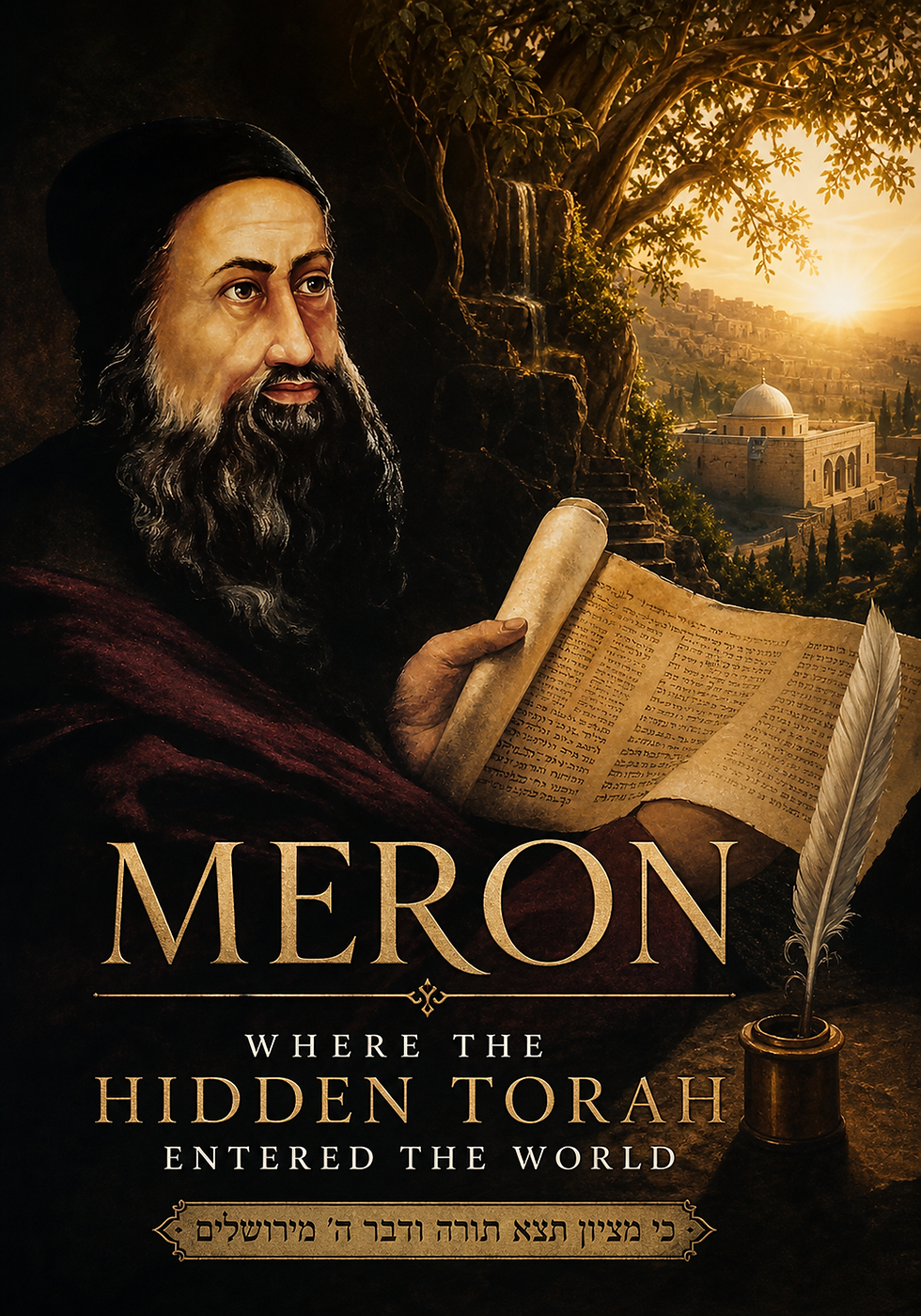
HaRashbi — Rabbi Shimon bar Yochai — is not merely one sage among many. He marks a decisive turning point in how Torah is revealed and understood.
He lived in a time when Torah stood under threat—physically from Roman oppression and spiritually from distortion. As a תלמיד (talmid — student) of Rabbi Akiva, he received the transmission of Torah in its fullness, both נגלה (Nigleh — revealed law) and נסתר (Nistar — hidden wisdom). Yet his role was not simply to preserve what he received, but to bring the hidden dimension into expression.
The defining period of his life is the thirteen years he spent in concealment with his son, Rabbi Elazar. This was not mere refuge; it was total withdrawal from the physical world. In that state, Torah ceased to be something studied externally and became something perceived internally. The boundary between learning and being dissolved.
From that מקום (Makom — spiritual state), HaRashbi accessed what became known as the Holy Zohar. This is not a book in the conventional sense, but a revelation of how Divine light flows through creation, how the ספירות (Sefirot — Divine attributes) operate, and how each מצוה (mitzvah — commandment) affects the structure of all worlds.
The essential distinction in his approach is this:
Most sages taught what Torah says.
HaRashbi revealed how Torah is.
He taught that reality itself is Torah in expression—that creation is not separate from G-D but continuously sustained by His word. Every action of a person either aligns with that flow or conceals it.
This is why, when he emerged from the cave, he initially could not tolerate ordinary human activity. To one who sees existence as pure Divine expression, involvement in the mundane appears contradictory. Yet he returned with a corrected understanding: the purpose is not to reject the world, but to elevate it. That is the balance his teachings establish.
That balance finds its physical anchor in Meron.
Meron is not simply where HaRashbi is buried. It is where his final revelation is fixed within the world itself. On the day of his death, Lag BaOmer, he did not depart in concealment but in disclosure. He revealed his deepest teachings, drawing what was hidden into a form that could be received.
For this reason, Meron is not associated with mourning, but with שמחה (simchah — joy). A מקום קבורה (makom kevurah — place of burial) becomes a place of light. What would normally signify an end instead marks a beginning—the transmission of the inner Torah into the inheritance of כלל ישראל (Klal Yisrael — the collective of Israel).
This reflects the very essence of HaRashbi’s teaching. He showed that holiness is not removed from the world, but embedded within it. Meron stands as the living expression of that truth: a physical place that serves as a channel for the light he revealed.
The fires lit there are not symbolic alone; they reflect אור (or — light), the illumination of the hidden Torah brought into revelation. The gathering of the people reflects that this light was not left in the hands of the few, but given to the many.
His enduring influence is therefore clear:
Before HaRashbi, the inner Torah existed in concealment.
After HaRashbi, it became the inheritance of כלל ישראל, even if still veiled.
In later generations, through the Arizal and then Chassidut, that light was drawn down further into forms that could be grasped. But the root of that opening remains HaRashbi.
The movement is complete:
From concealment in the cave, where Torah became one with his being,
To revelation in teaching, where Torah was expressed,
To Meron, where that revelation was anchored within the world.
In its simplest expression:
Torah is not only instruction for life—it is the structure of life itself, and the means by which a person unites with G-D.
###
Bill White (Rami ben Ze'ev) is CEO of WireNews Limited, Mayside Partners Limited, MEADHANAN Agency, Kestrel Assets Limited, SpudsToGo Limited and Executive Director of Hebrew Synagogue
Rabbi Rami ben Ze’ev was previously known as Ram ben Ze’ev. The addition of the letter י represents a personal step of spiritual refinement and deeper alignment with Torah, expressing humility, growth, and a strengthened commitment to the service of G-D. All teachings and writings are now published under this name.