


JTA’s Dangerous Reinvention of Idolatry as Judaism
- Jewish Dispatch

- May 29
- 4 min read
by Rami ben Ze’ev
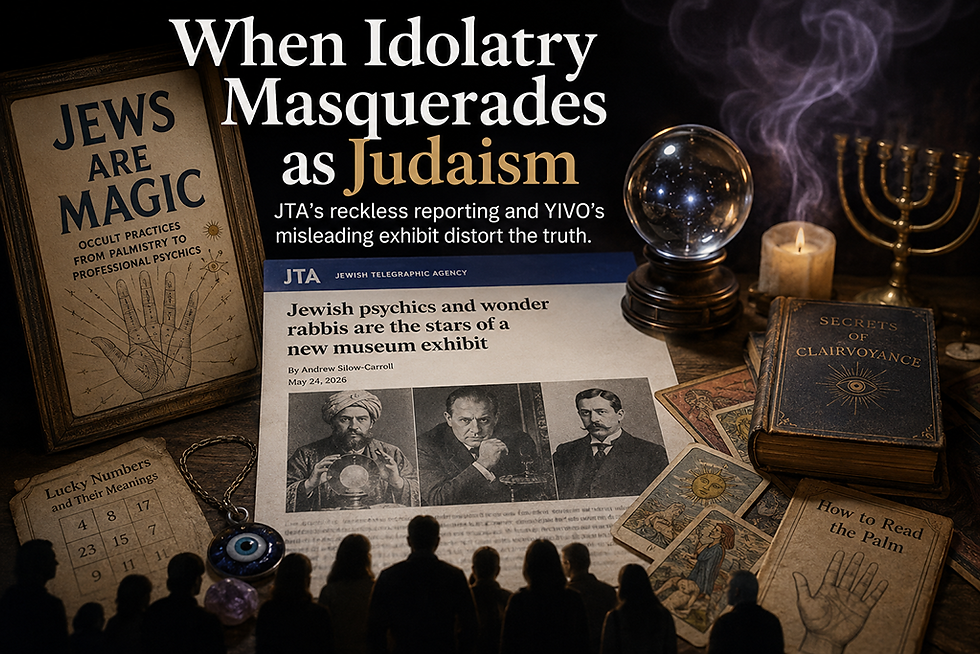
There is a profound difference between reporting on history and redefining Judaism.
The recent article published by the Jewish Telegraphic Agency, authored by Andrew Silow-Carroll and titled “Jewish psychics and wonder rabbis are the stars of a new museum exhibit,” crosses that line repeatedly. Rather than clearly distinguishing between Torah Judaism and the superstitions, occult practices, and folk beliefs that existed among some Jews, the article presents these practices as part of a broader and enduring “Jewish fascination.”
This is not merely poor journalism. It is reckless journalism.
The article opens by framing psychics, fortune tellers, amulets, occult practitioners, clairvoyants, and mystical charlatans as part of a Jewish cultural phenomenon worthy of celebration and exploration. While it briefly acknowledges that the Torah forbids many of these practices, that admission is quickly buried beneath a lengthy article that repeatedly normalises, romanticise, and contextualise them as authentic expressions of Jewish life.
The Torah could not be clearer.
In דברים (Devarim) 18, Jews are explicitly forbidden from consulting diviners, sorcerers, mediums, spiritists, and those who seek knowledge from the dead. These prohibitions are not obscure footnotes hidden in Jewish law. They are among the Torah’s strongest condemnations of spiritual corruption.
Yet the article repeatedly commits the same fundamental deception: it confuses what some Jews did with what Judaism teaches.
This distinction is critical.
Some Jews worshipped the Golden Calf.
Some Jews abandoned Torah.
Some Jews practised idolatry.
Some Jews assimilated entirely into foreign cultures.
No serious journalist would present those activities as expressions of Judaism itself.
Yet when discussing occultism, fortune-telling, séances, psychic readings, and magical practices, the article suddenly adopts a completely different standard. Instead of identifying these behaviours as deviations from Torah, it presents them as part of a rich Jewish mystical tradition.
That is historically dishonest.
Even more troubling is the article’s repeated conflation of קבלה (Kabbalah) with occultism.
Authentic Kabbalah is not astrology.
It is not tarot.
It is not palm reading.
It is not psychic prediction.
It is not communication with spirits.
It is not magical healing rituals.
Kabbalah concerns the hidden structure of Creation, the relationship between man and G-D, the nature of the soul, and the spiritual dimensions underlying existence. To place it alongside clairvoyants, occult performers, and self-proclaimed psychics is like placing Torah scholarship beside carnival fortune tellers and suggesting they belong to the same intellectual tradition.
They do not.
The article also grants remarkable legitimacy to obvious charlatans.
One figure described in the article openly called himself “The Mahatma” and “The Apostle of the Kabbalah.” Another built a reputation around hypnosis, phrenology, telepathy, and self-invented pseudosciences. These individuals were not Torah authorities. They were entrepreneurs selling mystery, spectacle, and false hope to desperate people.
Yet the article approaches them with a tone of fascination rather than scrutiny.
This reflects a deeper problem increasingly visible throughout parts of modern Jewish media.
There is a growing tendency to treat Judaism not as a covenant with G-D rooted in Torah, but as a collection of cultural curiosities. Everything becomes Judaism. Mysticism becomes Judaism. Superstition becomes Judaism. Political ideology becomes Judaism. Social trends become Judaism.
Eventually Judaism itself disappears beneath the endless rebranding.
The role of a journalist is not merely to repeat narratives but to provide context. The role of an editor is not merely to publish stories but to ensure they do not fundamentally mislead readers.
The greatest irony of the article is that it was written by a Jewish journalist. Andrew Silow-Carroll is not an inexperienced writer. He serves as Managing Editor for Ideas at JTA. That reality makes the article more concerning, not less. One expects critics of Judaism to misrepresent Torah. It is far more damaging when the misrepresentation comes from within the Jewish community itself. By repeatedly associating Judaism with psychics, occultism, fortune-telling, clairvoyance, and magical practices, the article risks teaching readers that behaviours condemned by Torah are somehow representative of Jewish spirituality.
Readers unfamiliar with Torah could easily leave this piece believing that psychics, occultism, magical practices, fortune telling, and supernatural intermediaries occupy a legitimate place within Judaism. That conclusion would be completely false.
The tragedy is that there was a legitimate story to tell.
The issue is not that YIVO has assembled historical artefacts relating to Jewish occultists, psychics, and wonder workers. Such material may have genuine historical value. The problem begins with the exhibit itself. By calling the exhibition "Jews Are Magic," YIVO takes the behaviour of a minority of Jews, much of it in direct conflict with Torah, and presents it as though it reflects Jewish identity itself. Andrew Silow-Carroll's article compounds that error by repeatedly failing to distinguish between what some Jews practised and what Judaism teaches. Together, the exhibit and the article transform a story about deviation from Torah into a story about Judaism itself.
A museum exhibit examining occult practices among some Jews in Eastern Europe could have been historically valuable. It could have explored why vulnerable populations under oppression often turned toward superstition, folk remedies, and self-proclaimed wonder workers. It could have examined the tension between Torah prohibitions and popular practices.
Instead, the article largely abandons that distinction.
Journalism should clarify truth, not obscure it.
When a major Jewish publication presents practices condemned by Torah as part of a broader “Jewish fascination,” it is not educating readers. It is misleading them.
The result is not merely bad reporting.
It is the dangerous reinvention of idolatry as Judaism.
###
Bill White (Rami ben Ze'ev) is CEO of Jewish Dispatch Limited, Mayside Partners Limited, MEADHANAN Agency, Kestrel Assets Limited, SpudsToGo Limited and Executive Director of Hebrew Synagogue


