


Given a Choice to Be
- WireNews

- Feb 6
- 4 min read
by Elisheva bas Chana
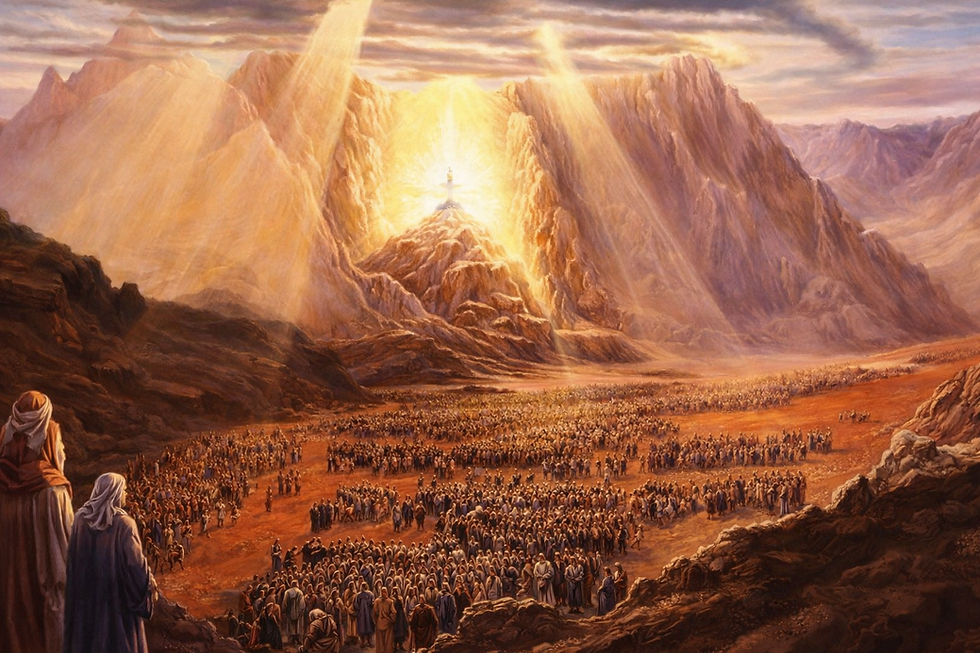
A letter in the scroll, a missing note makes a song incomplete. When one letter in the scroll is missing or damaged, chas v’shalom, it is incomplete.
We are here for a reason, chosen by HaShem, to be part of His plan. It is not a privilege, but a responsibility to make a broken world whole again.
To be part of HaShem’s plan, we have to have bitachon and emunah, a choice to make the song complete and not to be a missing letter.
It is a world of difference when we enter Shabbos, leaving the world behind. The Shabbos candles flickering, the table inviting; we are not to touch the light switch, careful to take the meat off the bone, not the other way around. Being vigilant to use the cold-water faucet on the right side of the sink, not using our phones, writing, or driving the car, to name some.
Prohibitions are essential and part of Shabbos, but they allow us to achieve the serenity, the kedusha in time, elevation, and dignity that are necessary to experience Shabbos. The prohibitions exist to serve the positive obligation to rest.
On the deepest level, HaShem controls everything. Shabbos is a time to come closer to the Creator of it all, and any act, even something as small as the touch of a light switch, contradicts that testimony, the covenant we have with HaShem.
It is the choice to be, the mirror of our inclinations. We were formed by HaShem as unfinished beings to give us the opportunity to create ourselves. Before we were born, our neshama had no association with the physical world; we were free of physical limitations, experiencing only the connection to our infinite Divine source.
When our neshama joins our body before birth, it becomes part of the restrictions and limitations of a physical being, and we can no longer maintain full integration with the Divine infinite reality. The neshama feels a sense of constriction, and even suffocation and loss, with a natural yearning to return to HaShem.
Our energy, identity, and intellect are physical aspects of our personality and have an expression in the physical world. Our essential self is not physical and has only an expression in the world through these physical aspects.
The physical energies allow us to exist as beings separate from HaShem. Through the mitzvos we perform, we are able to reach beyond the limitations of our understanding in connection to the spiritual realm. Through our sense of autonomous identity, we act upon that which determines our own environment and gives us a quality of Malchus, and allows us to connect to HaShem. This is the aspect through which we experience free will.
This alone does not define who we are, for without our root connection to HaShem, we would have no free will or individuality.
As individuals, having to fulfil the entire mission by ourselves can be overwhelming, and we do have a tendency to give up when the task seems impossible. When it comes to the Torah and the mitzvos, it is crucial to know that we are all in this together. No Jew can perform all 613 mitzvos by himself. It takes a team effort—kohanim, Leviim, and Yisroel, men and women, in unity.
Why Do We Need Unity?
We are all constantly searching for connection through objects and forces around us. When we are not in unity, we cannot achieve a single thing. We are all searching for meaning; what this really means is to create order out of disorder, to gain insight into the unknown, and to determine movement and behaviour.
Why Are We So Drawn to Unity?
Life itself is a search for unity, to a higher end; searching for HaShem is the ultimate unity. Unity is often confused with being together—forming a group of people with the same thoughts and acting the same—we believe that we could live in perfect harmony. In reality, unity is a process, whereas forming a like-minded group is a state of being. Unity is harmony in diversity.
The challenge of unity is to recognise the strength of different elements that bring us together, without annihilating anyone’s individuality.
When there is love between two people, each person is willing to bond while respecting each other’s individuality. This is what HaShem intended when He created us. He provided our reality with an independent existence that masks HaShem’s reality, with a distinct objective: to use our free will to access our desire to unite with G-dliness.
When we gain more knowledge about our physical reality, we begin to understand and see that there is a Divine unity that underlies and gives meaning to everything we do.
So when our neshama unites with our body, it is empowered to carry out its mission in the physical world. Each element in our universe reflects another shade of the Divine, and we unite body and soul to create a unity that will begin to spread throughout the entire world.
This is the challenge that we face: to reunite with HaShem by first recognising our neshama within ourselves, by recognising that HaShem is above and beyond us, by integrating HaShem into our lives.
Do We Ever Wonder How Heaven Meets Earth?
The entire process of creation was meant to challenge us to fulfil this mission by creating a bridge between our reality and HaShem’s reality. By creating unity, we create a ripple throughout the entire world, uniting all who have been fighting each other for thousands of years.
When we all fulfil our mission in unity, we may be zocheh to see the coming of the Moshiach.
###
Elisheva bas Chana – Celebrating the Heart of Yiddishkeit
Elisheva is a passionate voice for authentic Jewish life, blending Torah wisdom, mitzvos, and the timeless beauty of Yiddishkeit. Her writing shines a light on the strength and grace of Jewish women—from the legacy of Devorah Leah, daughter of the Alter Rebbe, to today’s women who live with faith, modesty, and purpose. Through her words, Elisheva celebrates Torah study, family purity, and radiant tznius, inspiring readers to embrace the joy, depth, and enduring spirit of Jewish tradition. Contact Elisheva.


